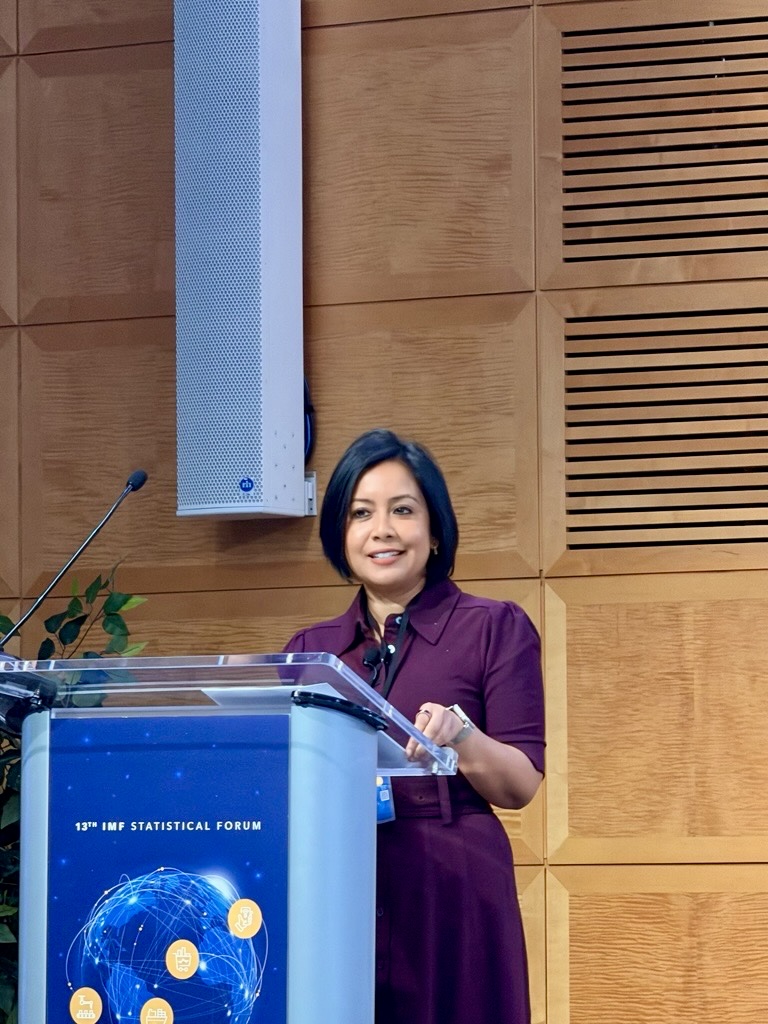
Bidisha Das
International Monetary Fund
Making sense of a world where money, markets, and technology are being rewritten.
Over eight years at the International Monetary Fund, Bidisha has helped central banks and regulators understand structural shifts in money and finance — from monetary and financial stability frameworks to the measurement architecture for digital assets, including crypto, stablecoins, CBDCs, and tokenized instruments.
Her work sits at the intersection of markets, policy, and data. She designs the systems institutions use to monitor liquidity, credit, systemic risk, and financial innovation — translating fast-moving developments into frameworks policymakers can actually use.
That work spans both global coordination and ground-level implementation. Bidisha leads international efforts across the G20 on digital money and cross-border financial data, coordinating across 24 economies and major multilateral institutions. She has advised central banks, finance ministries, and regulators across emerging and advanced economies, and delivered training for senior policymakers through IMF regional centers in Singapore, Vienna, Abu Dhabi, Almaty, and Delhi.
While her current focus is digital finance and macro-financial resilience, the broader thread has remained remarkably consistent: understanding how financial systems evolve, where vulnerabilities emerge, and how institutions adapt when the rules are still being written.
Earlier at the World Bank, she worked on sovereign debt and development finance, helping build the data infrastructure used to track external debt, financial flows, and emerging market vulnerabilities. That experience grounded her understanding of how financial stress moves through sovereign balance sheets and across borders.
Before that, she began her career in India as a competition and trade economist, working on landmark antitrust investigations — including some of the Competition Commission of India's earliest major cases — and advising governments and multilateral institutions on bilateral trade agreements, market access, and non-tariff barriers. It was an early education in how markets are structured, where frictions emerge, and how institutions respond.
Outside work, she applies the same analytical energy to Indian cricket selection debates and the occasional ambitious pickling experiment.
Education
- MA, International Policy — Stanford University
- BA, Economics — Shri Ram College of Commerce, Delhi University